BTB Venture Group: The Architecture of Predictable Growth
How a revenue engine, not a marketing machine, earned Forbes India's recognition.
There is a particular kind of company that doesn't announce itself loudly. It simply produces results, consistently, until the results become impossible to ignore. BTB Venture Group is that kind of company and its recent recognition in the Forbes India Top 200 is less a milestone than a confirmation of something that was already true on the ground.
To understand why that recognition matters, you first have to understand the problem BTB was built to solve.
The Industry's Fundamental Confusion
Across the B2B landscape, a subtle but damaging misalignment has become standard practice. Companies measure activity and call it progress. They count leads and call it revenue. They generate noise and call it pipeline. The metrics look healthy. The dashboards are full. And yet growth stalls — because the thing being measured is not the thing that actually moves a business forward.
BTB Venture Group was founded on a refusal to participate in that confusion.
Where most demand generation firms stop at lead volume, BTB built its entire model around a harder, more valuable question: does this create revenue?
That question restructured everything, the targeting methodology, the outreach strategy, the metrics used to define success, and the way client partnerships are structured.

A Revenue Engine, Not a Lead Factory
The distinction between leads and pipeline is easy to articulate. It is very difficult to operationalize. Most firms don't cross that line because crossing it requires genuine accountability for outcomes, not just activity.
BTB's approach is built around direct engagement with decision-makers and buying committees, the people who actually control budget and sign contracts. This isn't a differentiation claim. It is an architectural choice that permeates every campaign the company runs. Intent-based outreach. Account-based targeting. Context-driven sequencing. Each element is designed not to generate responses, but to generate conversations that convert.
The result is what the company calls a predictable revenue engine, a system where pipeline creation, revenue influence, and customer acquisition cost are the primary measures of success, not open rates or click-through percentages.
Zero-Budget as a Strategic Principle
One of the more counterintuitive aspects of BTB's model is its deliberate distance from paid media dependency. In an industry that has largely accepted "spend more to grow more" as an axiom, BTB built its pipeline through precision and execution rather than budget.
This is worth examining carefully, because it is often misread as a constraint rather than a choice. Heavy ad budgets create scale, but they also create dependency and erode margins. When paid channels underperform, companies without organic pipeline infrastructure are left exposed. BTB's model is designed to be resilient precisely because it is not dependent on any single channel.
The strategic logic is straightforward: if your growth requires perpetual ad spend to sustain itself, you haven't built a growth system. You've rented one.
The Alignment Problem and How RevOps Solves It
One of the most persistent sources of lost revenue in B2B organizations is the gap between sales and marketing. Sales teams complain about lead quality. Marketing teams point to volume. Customer success teams absorb the fallout from both. Meanwhile, revenue potential evaporates in the space between functions.
BTB's RevOps model was designed to close that gap structurally. By locking sales, marketing, and execution into a single system, with shared definitions, shared accountability, and shared metrics, the company eliminates the misalignment that typically causes pipeline leakage. There are no handoff failures because the model doesn't depend on handoffs.
This is, arguably, the most difficult thing BTB does. Technology can automate targeting. Messaging can be refined through iteration. But genuine operational alignment across functions requires a clarity of design that most organizations never achieve.
Precision at Global Scale
BTB operates across the United States, APAC, the Middle East, and India. Geographic reach at that level creates real operational complexity different buyer behaviors, different regulatory environments, different competitive landscapes.
The company's response to that complexity is not to standardize into genericness, but to maintain account-level precision regardless of geography. Every campaign is built for the specific account, the specific context, and the specific moment in the buying cycle. The scale is in the infrastructure. The execution remains surgical.
On the Forbes Recognition
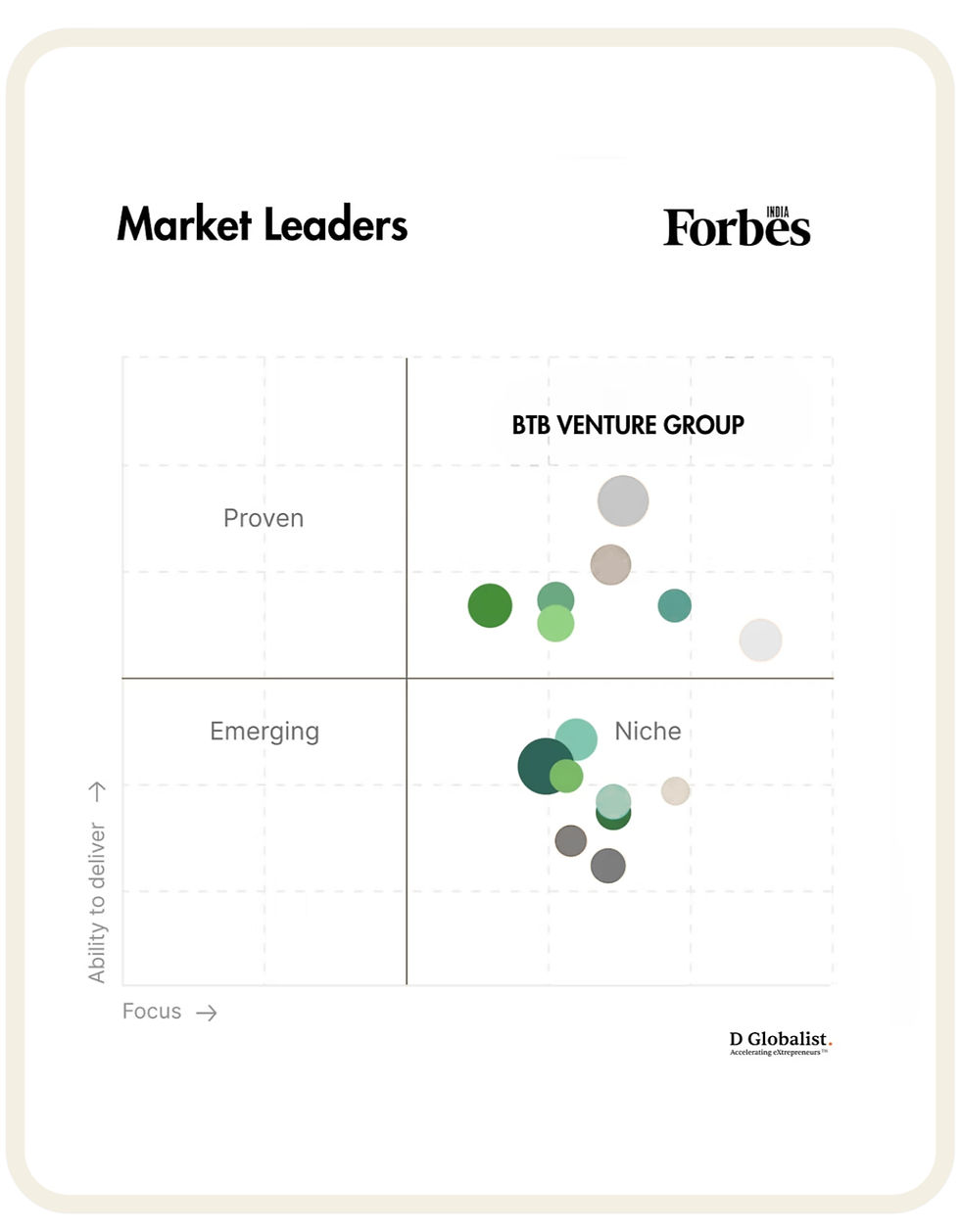
It would be easy to lead with the Forbes India listing. BTB has chosen, deliberately, not to.
That ordering reflects something important about how the company thinks about external validation. Recognition from a publication like Forbes is meaningful, it signals that the results BTB has been producing are visible enough, and credible enough, to survive scrutiny. But the recognition didn't create the results. The results created the recognition.
This is a distinction that separates companies with genuine capability from companies with sophisticated positioning. One builds the proof first. The other builds the story first and hopes the proof follows.
What Consistency Actually Requires
Anyone can promise pipeline. Delivering it consistently across geographies, across industries, across market conditions — requires something most agencies are not structured to provide: genuine ownership of outcomes.
BTB's client relationships are structured around that ownership. The company doesn't take on projects. It takes responsibility for revenue outcomes. That model self-selects for clients who want predictability over promises, and it produces partnerships measured in years rather than quarters.
Predictable pipeline, once experienced, changes what a company expects from its growth partners. That is the most durable competitive advantage BTB has built not the Forbes listing, and not the methodology. It's the standard of evidence that its clients now hold everyone else to.