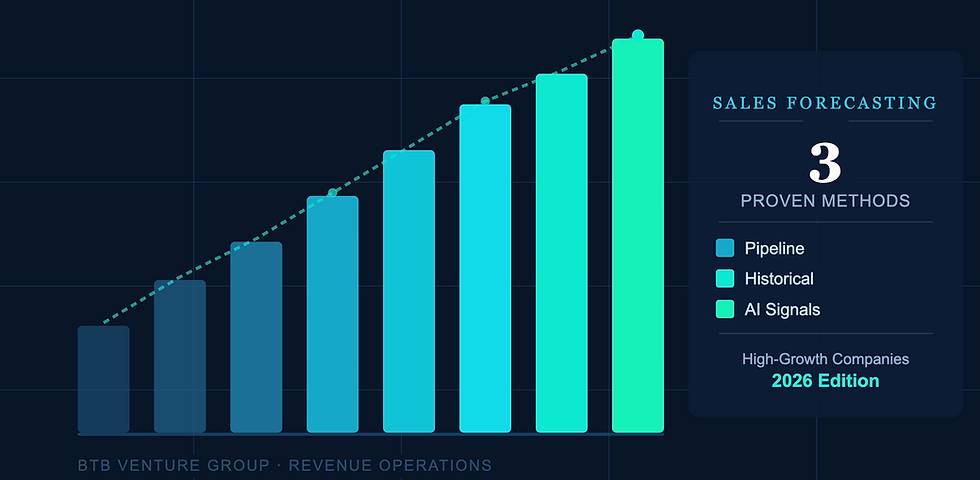
3 Sales Forecasting Methods High-Growth Companies Are Using in 2026

Struggling to predict next quarter's revenue with confidence? We'll audit your current forecasting setup, identify where your pipeline is bleeding, and show you exactly what a layered RevOps forecast looks like for your business, book a meeting at www.btbventure.com
Most sales forecasts are fiction.
A manager asks reps what they think will close. The reps inflate their numbers. The spreadsheet goes to leadership. Leadership makes hiring, budget, and headcount decisions based on data that was optimistic at best and dishonest at worst.
This worked when markets moved slowly and buyers were easy to read. Neither of those things is true anymore.
Today's buyers complete most of their research before your rep ever speaks to them. Buying committees have grown. Economic uncertainty has made CFOs the unofficial veto holder on every deal. Sales cycles stretch unpredictably across industries and geographies.
Companies still running gut-feel forecasts are paying for it through missed targets, bloated headcount, cash flow surprises, and investor conversations that erode trust.
Forecasting is no longer a sales admin task. It is one of the most consequential strategic disciplines in a scaling business.
The companies getting it right are not using one method. They are using three, layered on top of each other.
Method 1: Pipeline-Based Forecasting
The Foundation You Cannot Skip
Pipeline forecasting is the starting point for every serious revenue operation. It estimates future revenue by examining what is currently sitting in your CRM, assigning each opportunity a value, a sales stage, a close date, and a win probability, and then calculating weighted expected revenue.
The math is simple. The discipline required to make it reliable is not.
Opportunity | Value | Probability | Forecasted Revenue |
Deal A | $50,000 | 80% | $40,000 |
Deal B | $30,000 | 50% | $15,000 |
Deal C | $20,000 | 30% | $6,000 |
Total | $61,000 |
When the CRM is clean and reps are honest, pipeline forecasting gives leadership clear visibility into momentum, bookings, and quarter-end projections. It also surfaces individual rep performance issues before they become revenue problems.
Where It Breaks Down
The model is only as good as the data feeding it. Most CRMs are graveyards of stale opportunities, deals that died six months ago and were never marked lost, close dates that have been pushed three quarters in a row, and probabilities inflated by reps who mistake optimism for analysis.
The most common failure modes are:
Deals that never die. Opportunities stay open indefinitely because no one wants to mark a loss.
Probability inflation. Reps systematically overestimate close likelihood. It is not always dishonesty. It is human psychology.
Close date fiction. A deal that was supposed to close in Q1 is now closing "next month" for the fifth consecutive month.
CRM avoidance. If your team treats CRM entry as punishment, your forecast is structurally broken.
How Leading Teams Fix This in 2026
The best revenue operations teams have stopped relying on reps to self-police pipeline hygiene. They automate it. Deal aging alerts, stage conversion tracking, AI-driven health scores, and weekly forecast category reviews have replaced the quarterly pipeline scrub.
Pipeline forecasting must remain your foundation. It should never be your only layer.
Method 2: Historical Conversion Forecasting
Let the Data Speak Instead of Your Reps
Historical conversion forecasting removes human judgment from the equation and replaces it with a question that has a factual answer: what has actually happened in the past?
Instead of asking what a rep thinks will close, this model asks what percentage of leads historically became opportunities, what percentage of those closed, how long that took, and what the average deal was worth.
Take a company with the following baseline metrics:
1,000 leads generated per month
10% convert to opportunities
25% of opportunities close
Average deal value of $20,000
Expected monthly revenue: 1,000 × 10% × 25% × $20,000 = $500,000
No rep input required. No optimism bias. Just math applied to demonstrated performance.
This model has one critical assumption baked in: that the future will look like the past. That assumption fails the moment anything meaningful changes.
Launching into a new market, releasing a new product, restructuring pricing, navigating an economic shock, or onboarding a large wave of new reps will all distort historical baselines. When your business is in transition, historical conversion data can give you false confidence in a projection that no longer reflects reality.
How Leading Teams Use This in 2026
The most sophisticated revenue organizations are not running one company-wide historical forecast. They are running multiple, segmented by industry vertical, geographic market, product line, customer size, and sales team. A single blended conversion rate masks the performance differences that matter most. Segment the data and you find the real story.
Method 3: AI and Revenue Signal Forecasting
Pipeline stages and historical averages tell you what has happened. Revenue signal forecasting tells you what is actually happening right now, at the buyer level, in ways that your CRM will never capture on its own.
AI-powered forecasting systems pull signals from across the revenue stack: email engagement patterns, meeting frequency and recency, proposal view activity, executive sponsor involvement, product usage data, website behavior, and stakeholder participation trends. The model synthesizes these signals continuously and produces a dynamic forecast that updates as buyer behavior changes.
The difference this makes is profound. Consider two deals, each valued at $100,000 and both sitting at 80% probability in your CRM.
Deal A: Five stakeholders engaged across three levels of the organization. Four meetings completed in the last three weeks. Proposal opened and reviewed multiple times. Legal review initiated.
Deal B: One stakeholder engaged, no response in three weeks. Proposal sent but never opened. Last meaningful activity was five weeks ago.
Traditional forecasting treats these identically. AI forecasting recognizes that one of these deals is on track and one is already lost. The difference in forecast accuracy compounds across every deal in your pipeline.
Revenue signal forecasting does not just improve accuracy. It changes how sales leaders operate. Deals at risk surface before the quarter-end scramble. Revenue leakage becomes visible in real time. Sales coaching becomes targeted rather than generic. Win rates improve because attention goes to the right opportunities at the right moment.
AI forecasting is not a plug-and-play solution. It requires clean underlying CRM data, disciplined sales processes, well-integrated systems, and enough historical performance data for the model to learn from. Organizations that treat it as a shortcut around operational discipline will be disappointed. Organizations that invest in the foundation first will see compounding returns.
The companies achieving the highest forecast accuracy are combining data from CRM systems, marketing automation platforms, conversation intelligence tools, product analytics, and customer success systems into a unified revenue intelligence layer. The forecast is no longer a spreadsheet updated weekly. It is a living model that reflects reality as it changes.
The Layered Framework: Why All Three Work Together
The highest-performing revenue organizations do not debate which forecasting method to use. They use all three simultaneously and treat divergence between the models as a diagnostic signal.
Layer 1 — Pipeline Forecast: Short-term visibility into current quarter momentum and individual deal status.
Layer 2 — Historical Conversion Forecast: Statistical confidence grounded in demonstrated performance patterns.
Layer 3 — Revenue Signal Forecast: Real-time buyer intelligence that captures what CRM stages cannot.
When all three layers align on a revenue projection, leadership can act with confidence. When they diverge, something important is happening in your pipeline that demands investigation. That divergence is not a failure of the system. It is the system working.
The Bottom Line
The companies that win in 2026 are not the ones with the largest pipelines or the most optimistic reps. They are the ones that know, with evidence-backed precision, what revenue is coming, when it is coming, and where it is at risk.
Accurate forecasting enables better hiring. It enables smarter resource allocation. It produces investor conversations that build credibility rather than erode it. Most importantly, it transforms a revenue function from one that reacts to outcomes into one that shapes them.
The organizations still relying on rep intuition and quarterly spreadsheet scrubs are not just behind on process. They are making consequential business decisions on information they should not trust.
The companies that build layered, data-driven forecasting capabilities now are not just improving accuracy. They are building one of the most durable competitive advantages available to a scaling business.

Comments